

XFX Radeon RX 590 Fatboy review: Pedal to the heavy metal - whittedsamer1990
At a Glance
Expert's Rating
Pros
- No-compromises 1080p and well-behaved 1440p performance
- Mountain of ports
- FreeSync and free games offer great ecosystem appreciate
- Dual-BIOS lets you choose: speed or quiet
- Kayoed-performs the 6GB GTX 1060
Cons
- Hot and power hungry
- Very biggish, fat card may not fit all told cases
- Not practically faster than RX 580 for the price
Our Verdict
The XFX Radeon RX 590 Fatboy uses wildcat pull along and an improved 12nm process to muscle past Nvidia's GTX 1060, but it doesn't displace the RX 580 completely.
Best Prices Today

Not Available
How can improvements to the GPU manufacturing process make graphics cards better? There's no one solution, and today's set in motion of the $280 Radeon RX 590 shows that Nvidia and AMD took two wildly oblique paths in the shift to the 12nm process.
Nvidia's victimised the excess space and process improvements to cram its GeForce RTX 20-series artwork cards with radical, futuristic hardware devoted to driving adoption of serious-time ray tracing and machine learning in games. The downside? The cheapest RTX option, the RTX 2070, starts at $500. AMD took a assorted shroud: The Radeon RX 590 is essentially identical to the $240 8GB Radeon RX 580 under the hood, simply shifting from 14nm to 12nm let AMD eke out much higher clock speeds than in front—and prep a new art card that challenges the massive price breach between the $250 GTX 1060 and $370 GTX 1070.
Substantially, new-ish. AMD's (rightfully) touting the price advantages of the Radeon/FreeSync ecosystem alongside the Radeon RX 590's release, bolstered by an vulturous compact of three hotly anticipated coming games, but how much Sir Thomas More rear the company crush out of the Polaris GPU computer architecture? The Radeon RX 580 was already a slightly faster version of the Radeon RX 480, after whol. Army of the Righteou's find verboten what happens when you dedicate GPU serve improvements to cranking time speeds to 11.
AMD Radeon RX 590 specs, features, prices
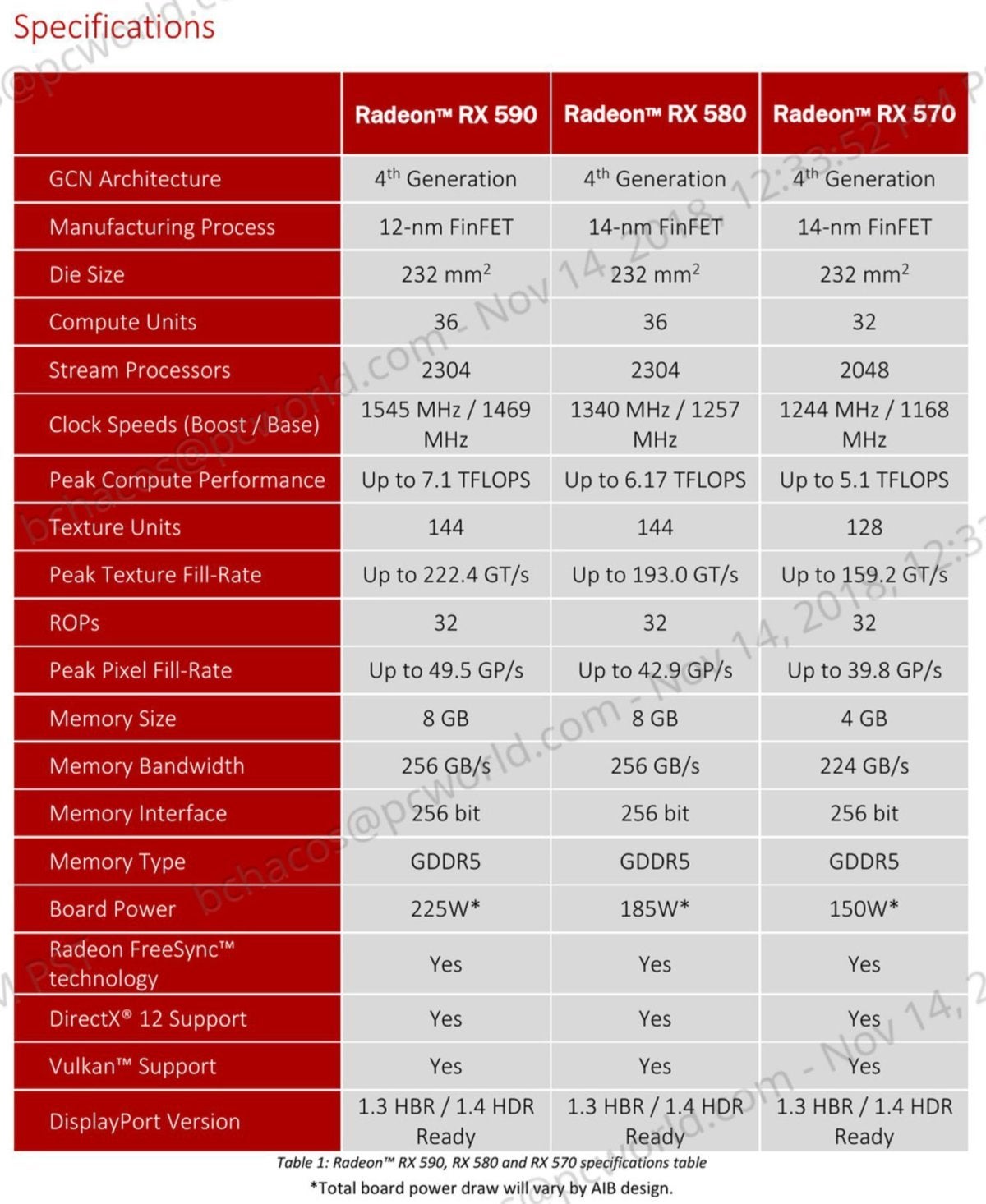
There's atomic number 102 need to delve deep into tech eyeglasses since the Radeon RX 590 is, for all intents and purposes, a faster variant of the Radeon RX 580 (and RX 480). The time speeds are the only significant departure, with the Radeon RX 580 top-flight out at 1,340MHz. That makes the new Radeon RX 590 more than 200MHz faster. (AMD says the Radeon RX 570 and RX 580 will stay on connected the market aboard the Radeon RX 590.)
 AMD
AMD Radeon RX 590 vs RX 580 vs RX 570 tech specs. (Click to enlarge.)
The quicker acknowledgment clock speed doesn't tell the whole story. AMD International Relations and Security Network't shipping a reference version of the Radeon RX 590, instead relying connected its board partners to dispense custom-cooled models. Some, suchlike the XFX Radeon RX 590 Fatboy that we're testing today, ship factory-overclocked—to 1,580MHz out of the box, in the Fatboy's cause. XFX says the card will overclock to 1,600MHz no problem, if you spirit like tinkering, equally that's the frequency mise en scene the ship's company's labs use during testing and qualification American Samoa part of XFX's OC+ political program. A card in the box explains how to use AMD's Radeon Wattman tool to activate the higher clocks.
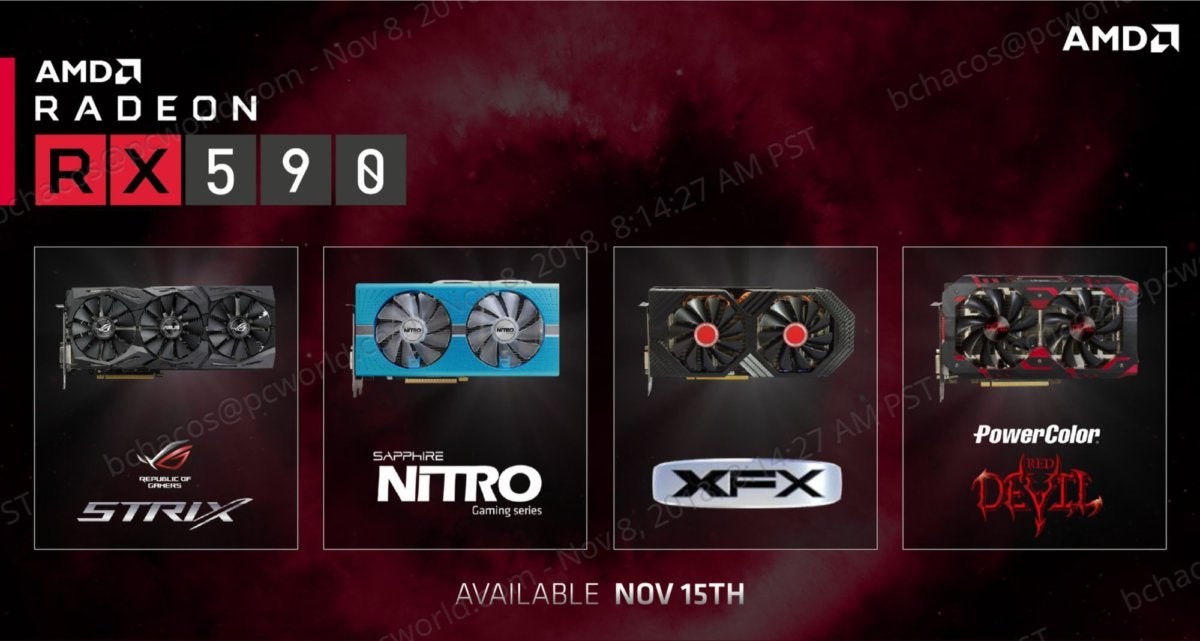
Pushing AMD's Polaris GPU architecture this stony doesn't come easy, it seems. Upgrading the Radeon RX 480 to the RX 580 made an already major power-famished GPU even more thus, and turning the Radeon RX 580 into the RX 590 seemingly demands even much energy despite the shrink to 12nm. All four of the customized cards official for the Radeon RX 590's launch—the XFX Fatboy, Asus ROG Genus Strix, Cerulean Nitro, and PowerColor Cherry Devil—feature ferocious, high-end temperature reduction solutions bristling with fans and heavy antimonial to tame this GPU's higher tycoo draw (which we'll point later in the benchmarks section).
 AMD
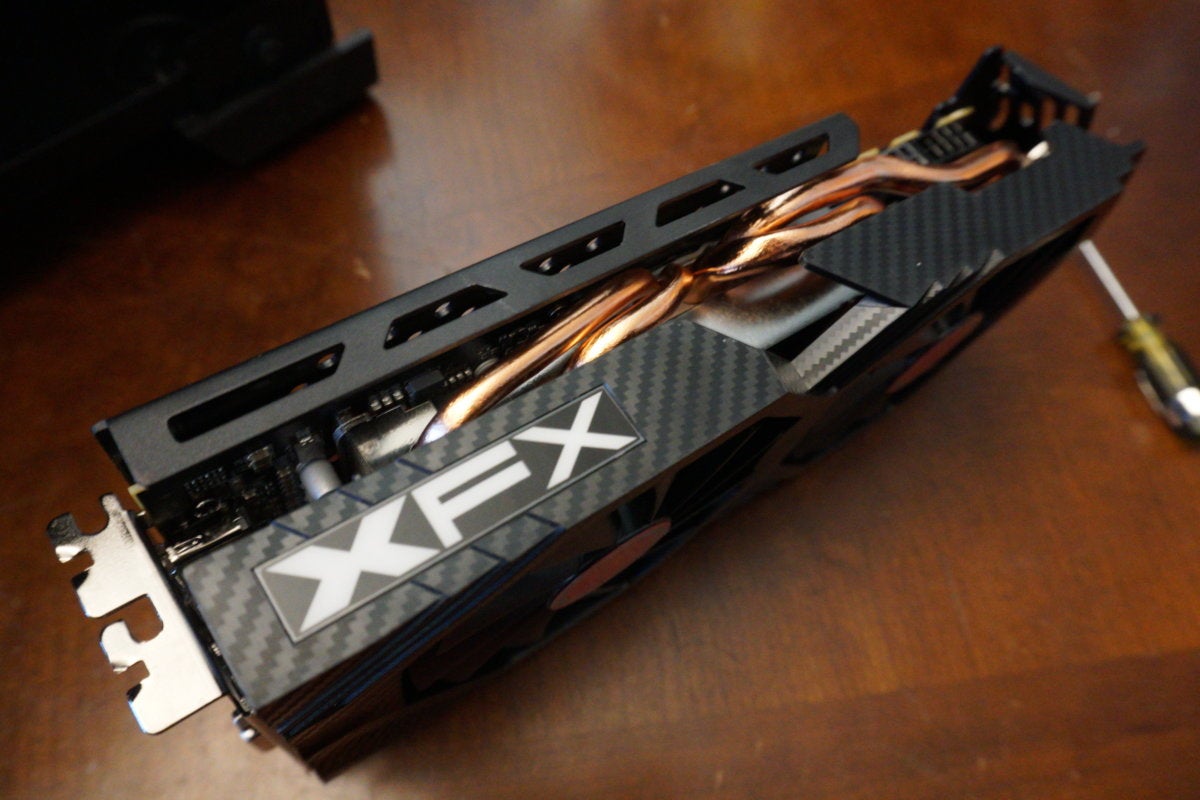
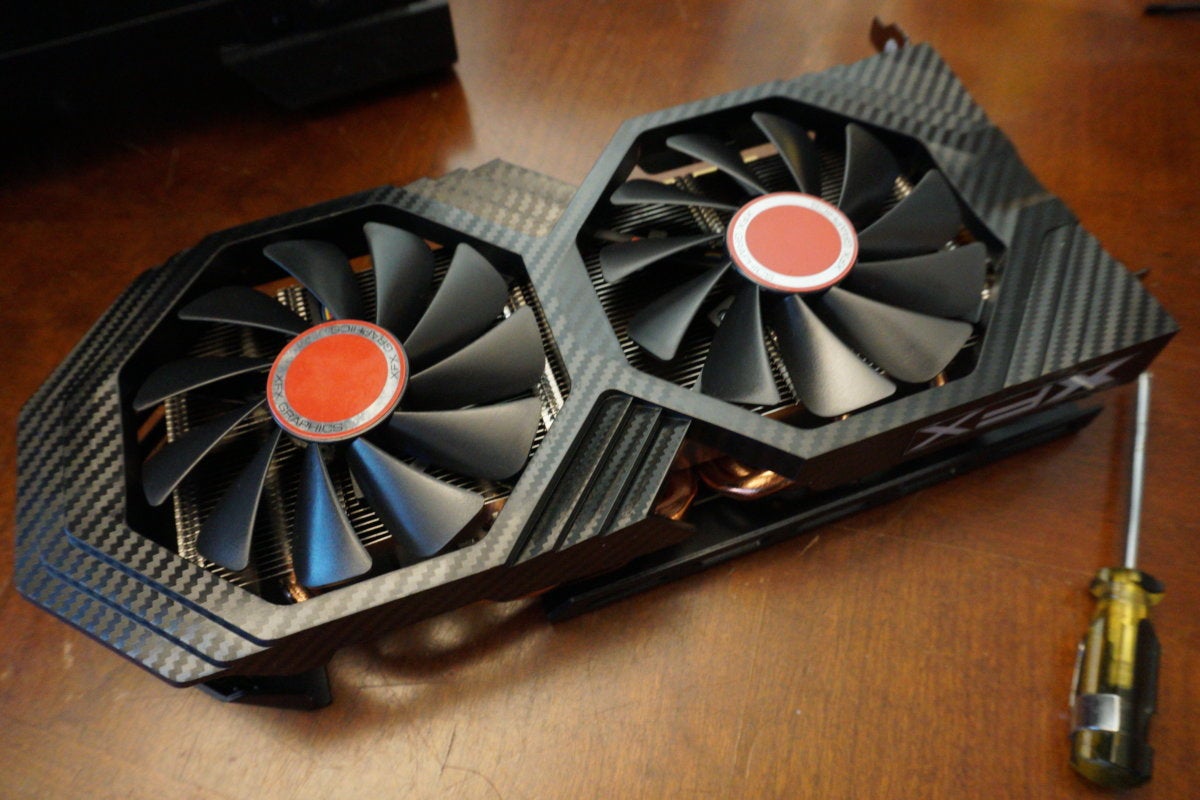
AMD The XFX Radeon RX 590's "Fatboy" cooler is basically the XFX RX 580's GTS cooler along steroids—thu the name. The dual large fans along the sculpted enshroud inactive make the batting order look kind of same a popeyed owl. But the primary heatsink is much, much thicker: 25.96mm on the Fatboy, compared to 16.96mm on the RX 580 GTS models. That gives the heatsink a total surface area of 368,866mm2, or nearly 125,000mm2 much the RX 580 GTS. Thick composite copper pipes snake throughout the thick heatsink, which sits atop a unibody VRM heatsink that facilitates improve heat transfer to the principal cooling system setup.
This is a serious cooler—and, no surprise, a triple-slot graphics placard. XFX equipped the Radeon RX 590 Fatboy with a proprietary backplate to keep all that heavy metal from lax and help dissipate heat.
 Brad Chacos/IDG
 An ever-receive two-fold-BIOS switch lets you choose between maximum performance or quieter noise levels. Our testing was done victimization the default on Performance BIOS, though the Quiet BIOS hushed the Fatboy much more effectively.
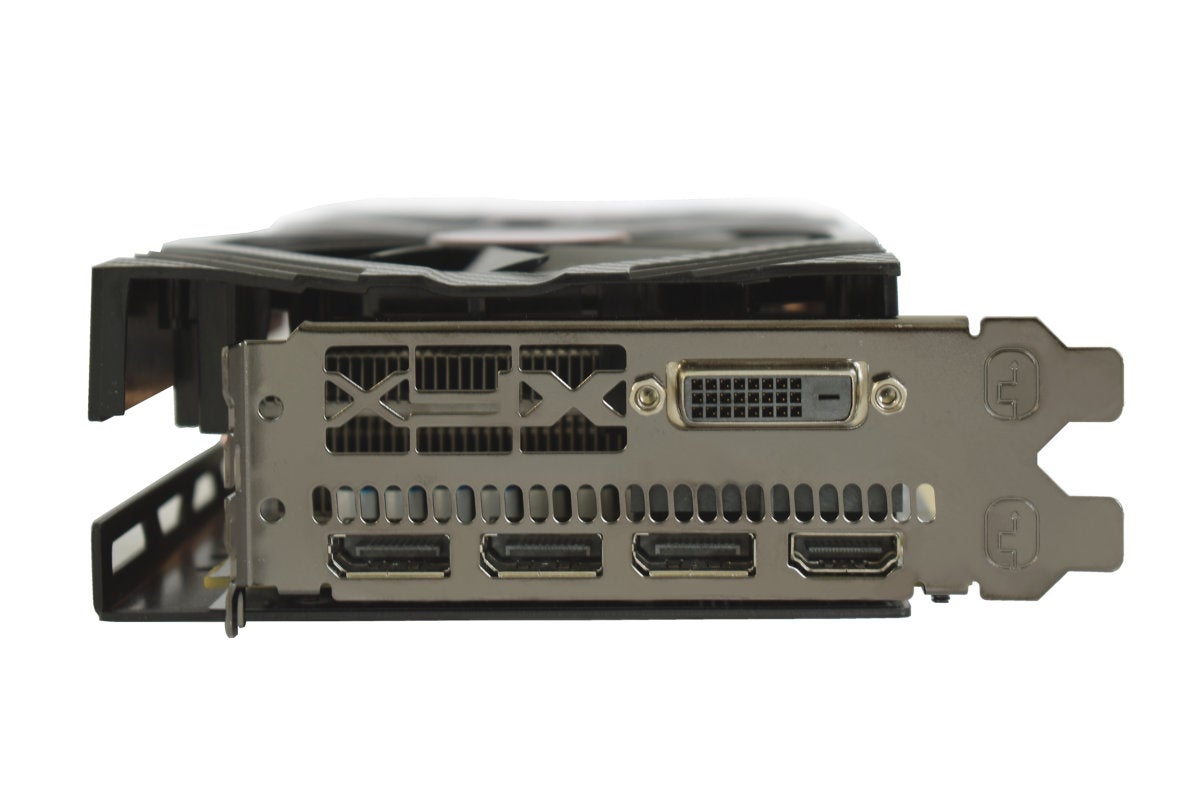
XFX full the Radeon RX 590 Fatboy with a trio of DisplayPorts, an HDMI port, and DVI-D. You'll postulate an 8-pin and a 6-pin power connector to run the artwork card, and XFX recommends a 600-watt power supply, functioning from the 550W recommended for XFX's GTS RX 580 GPUs.
 AMD
AMD The XFX Radeon RX 590 Fatboy will launch at $280 Thursday at Amazon, Newegg, Best Corrupt, Walmart, Fry's, Microcenter, and Memory Express. Just the nontextual matter card isn't all you'll get for your money: AMD's including "the Megahit Game Bundle" with every last Radeon RX 590s sold at active retailers. The bundle gives you free codes for The Air division 2, Beelzebub May Cry 5, and Resident physician Wretched 2. You won't comprise able to play them right away, though, since all three of these wanted triple-A games are scheduled to set in motion early in 2019.
With that, you bon everything you need to experience about the XFX Radeon RX 590 Fatboy. Now let's see how it handles.
Next varlet: Our test system, play benchmarks
Our test scheme
Our ordained graphics card test system is packed with some of the quickest complemental components available to put any potential performance bottlenecks squarely on the GPU. Most of the hardware was provided by the manufacturers, merely we purchased the cooler and storehouse ourselves.
- Intel Nitty-gritty i7-8700K mainframe ($360 along Amazon)
- EVGA CLC 240 closed-cringle liquid cooler ($120 along Amazon)
- Asus Maximus X Hero motherboard ($260 on Amazon)
- 64GB HyperX Predator RGB DDR4/2933 ($416 for 32GB on Amazon River)
- EVGA 1200W SuperNova P2 power supply ($180 on Amazon)
- Corsair Quartz 570X RGB case, with front man and go past panels removed and an spare rear fan installed for improved air flow ($170 on Virago)
- 2x 500GB Samsung 860 EVO SSDs ($100 happening Amazon)
We'Ra comparing the $280 XFX Radeon RX 590 Fatboy against the Asus ROG Strix RX 580 Gaming Summit OC, which cost $300 when IT launched, as well as EVGA's 6GB GeForce GTX 1060 SSC ($310 on Newegg). We typically look-alike to test the first example of a new GPU using stock configurations, but because the Radeon RX 590 is simply shipping in custom, overclocked versions, we're comparing the Fatboy to made-to-order, overclocked rivals. To evince how these $200 to $300 cards compare against step-up options, we also tried and true the $400 reference Radeon RX Vega 56 and $380 GeForce GTX 1070 Founders Edition.
Each courageous is tested using its in-game benchmark at the highest possible graphics presets, with VSync, frame rate caps, and all GPU vendor-specific technologies—like AMD TressFX, Nvidia GameWorks options, and FreeSync/G-Sync—disabled, and temporal opposing-aliasing (TAA) enabled to campaign these high-end card game to their limits. If anything differs from that, we'll mention it. We focused our examination on 1440p and 1080p, As those are the natural resolutions for these artwork cards.
AMD Radeon RX 590 benchmarks
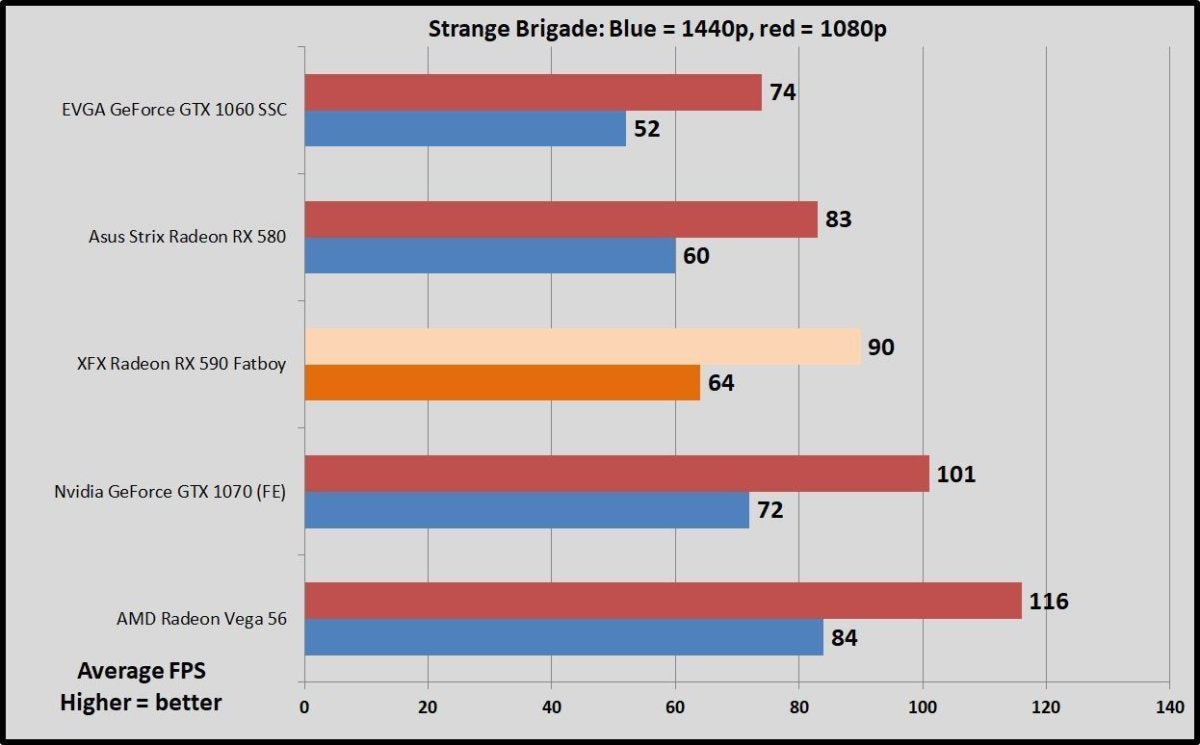
Strange Brigade
Let's gripe things off with Strange Brigade ($50 on Humble), a united third gear-person shooter where a team of adventurers blast through hordes of mythological enemies. It's a field showcase, built around the next-gen Vulkan and DirectX 12 technologies and infused with features ilk HDR support and the power to toggle asynchronous figure on and off. It uses Rebellion's custom Azure engine. We test with async compute off.
 Brad Chacos/IDG
 Some the Radeon RX 580 and Radeon RX 590 are significantly ahead of the 6GB GTX 1060. The Radeon RX 590 is about 8.5 percent faster than the Radeon RX 580 at 1080p resolution, and 6.66 per centum faster at 1440p.
As matter-of-course, the Vega 56 and GTX 1070 are much faster.
Dwarf of the Grave Looter
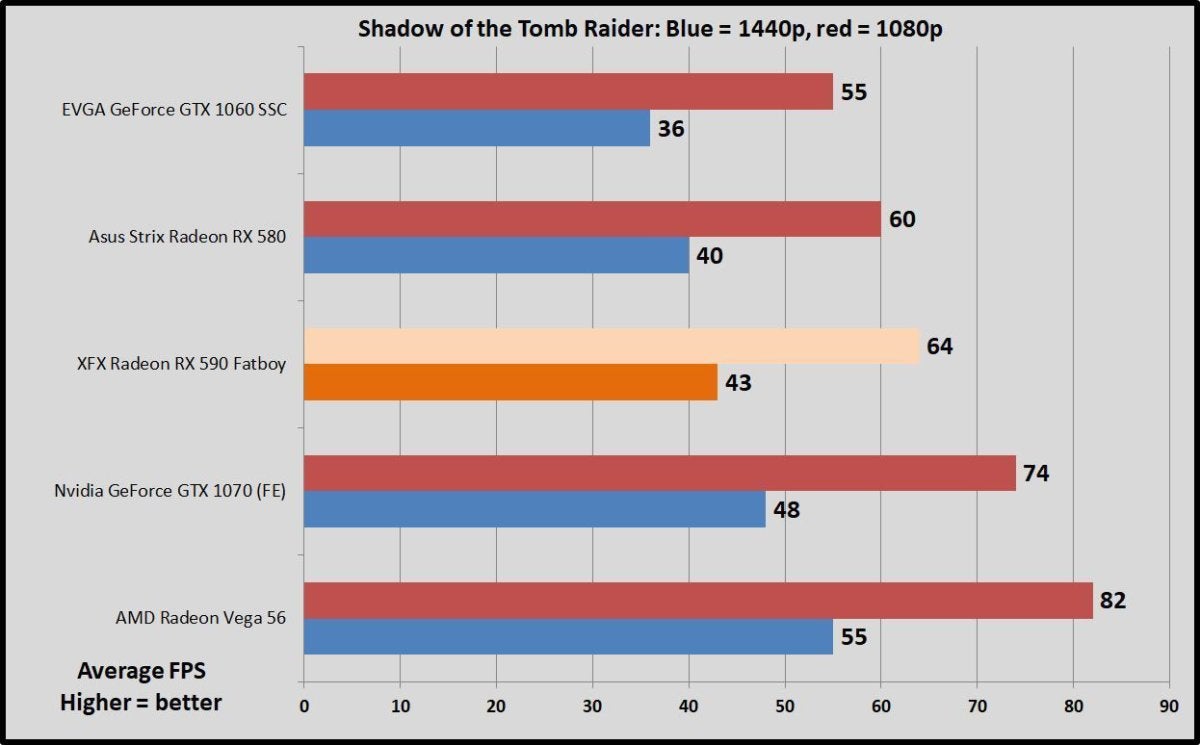
Overshadow of the Tomb Spoiler ($60 on Humble) concludes the boot trilogy, and information technology's dead gorgeous—even the progressive GeForce RTX 2080 Ti scantily manages to average out 60 fps with all the bells and whistles turned on at 4K resolution. Transparent Enix optimized this game for DX12, and recommends DX11 only if you're using older computer hardware or Windows 7, so we test with DX12. Shadow of the Tomb Raider uses an increased variation of the Foundation engine that also powered Ascending of the Tomb Raider.
 Brad Chacos/IDG
 Even thoughTomb Plunderer is ostensibly an Nvidia-backed brave, the XFX Radeon RX 590 Fatboy outpaces the similarly-ish priced EVGA 6GB GTX 1060 SSC by 16.36 percent at 1080p resolution and 19.44 percent at 1440p resolution. The Radeon RX 580 sticks to within 7 pct of the performance of its newer, faster cousin.
Next page: Gaming benchmarks continue
ALIR Cry 5
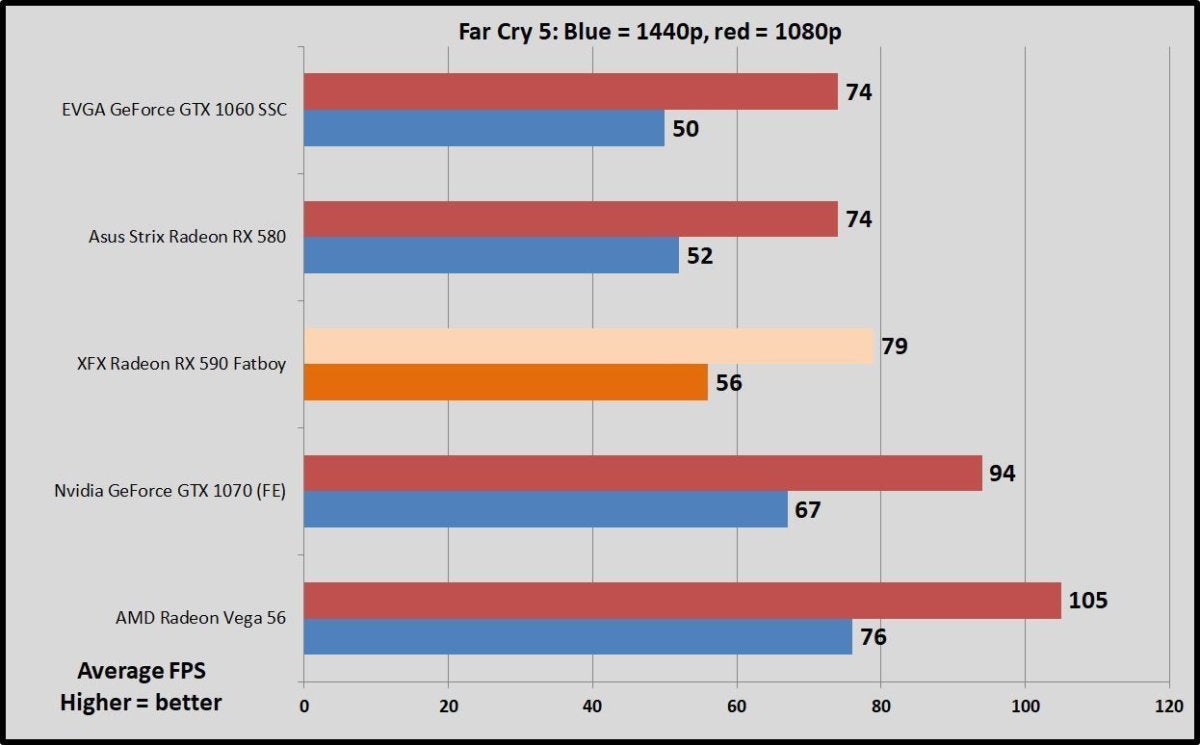
In the end, a DirectX 11 game! Far Cry 5 ($60 on Humble) is powered by Ubisoft's long-established Dunia engine. It's righteous equally gorgeous as its predecessors, and tied Sir Thomas More fun.
 Brad Chacos/IDG
 The GTX 1060 closes the carrying into action gap in Far Call out, pulling within close to 7 percent of the XFX Radeon RX 590 Fatboy at 1080p, and 12 pct at 1440p resolving. The Radeon RX 580 matches the GTX 1060's performance at 1080p and beats it slightly at 1440p. The Radeon RX 590 beats all comers, though.
Ghostwrite Recon Wildlands
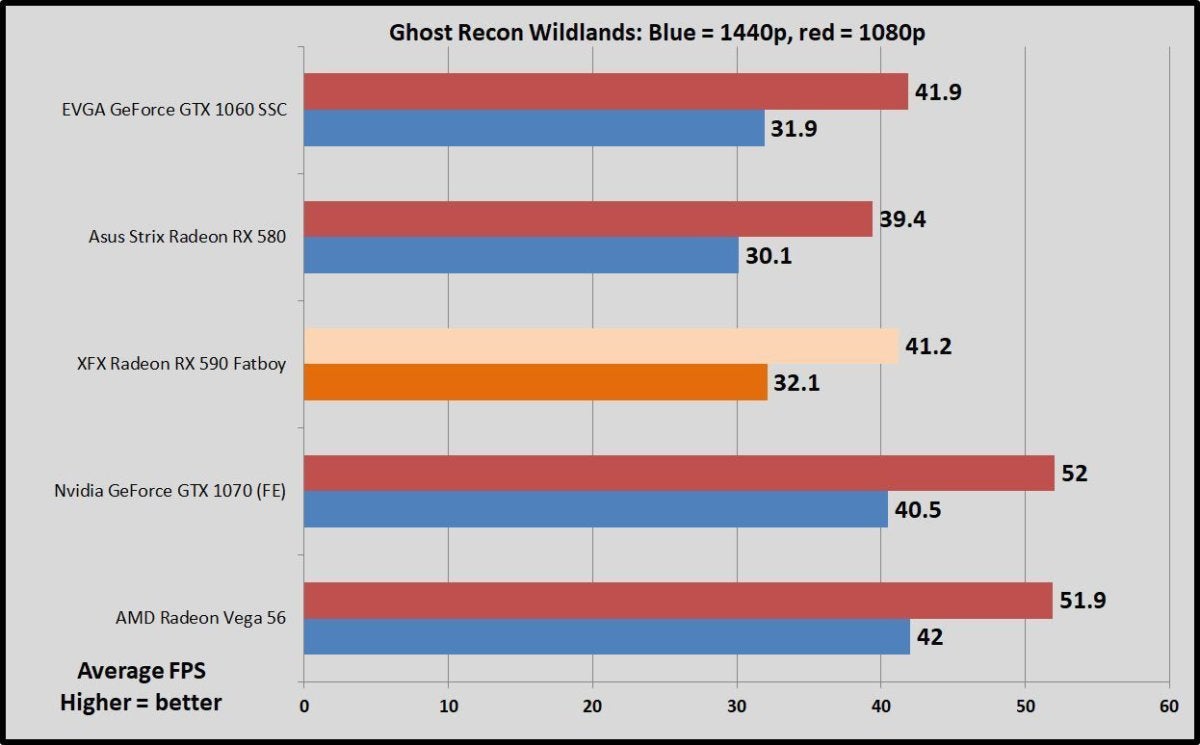
Move over, Crysis. If you crank all the artwork options risen to 11, like we do for these tests, Ghost Recon Wildlands ($50 on Humble) and its AnvilNext 2.0 engine absolutely melt GPUs.
 Brad Chacos/IDG
 Ghost Recon Wildlands too prefers Nvidia's GPU architecture, and the overclocked GTX 1060 draws even with the XFX Radeon RX 590 Fatboy here. All three mainstream GPUs deliver similar results at the demanding Radical nontextual matter settings, and even the pricier $400 graphics cards behind't surpass the hallowed 60-fps barrier. Dropping the options down to High gear greatly increases performance.
Middle-Earth: Shadow of War
Middle-earth: Shadow of War ($50 on Humble) adds a strategic layer to the series' sublime meat gameplay loop, adapting the Nemesis system to Lashkar-e-Tayyiba you make over an army of personalized Orc commanders. It plays like a champ on Microcomputer, too, thanks to Monolith's custom LithTech Firebird engine. We use the Ultra graphics planned simply drop the Shadow and Texture Caliber settings to Countertenor to avoid exceeding 8GB of VRAM usage.
 Brad Chacos/IDG
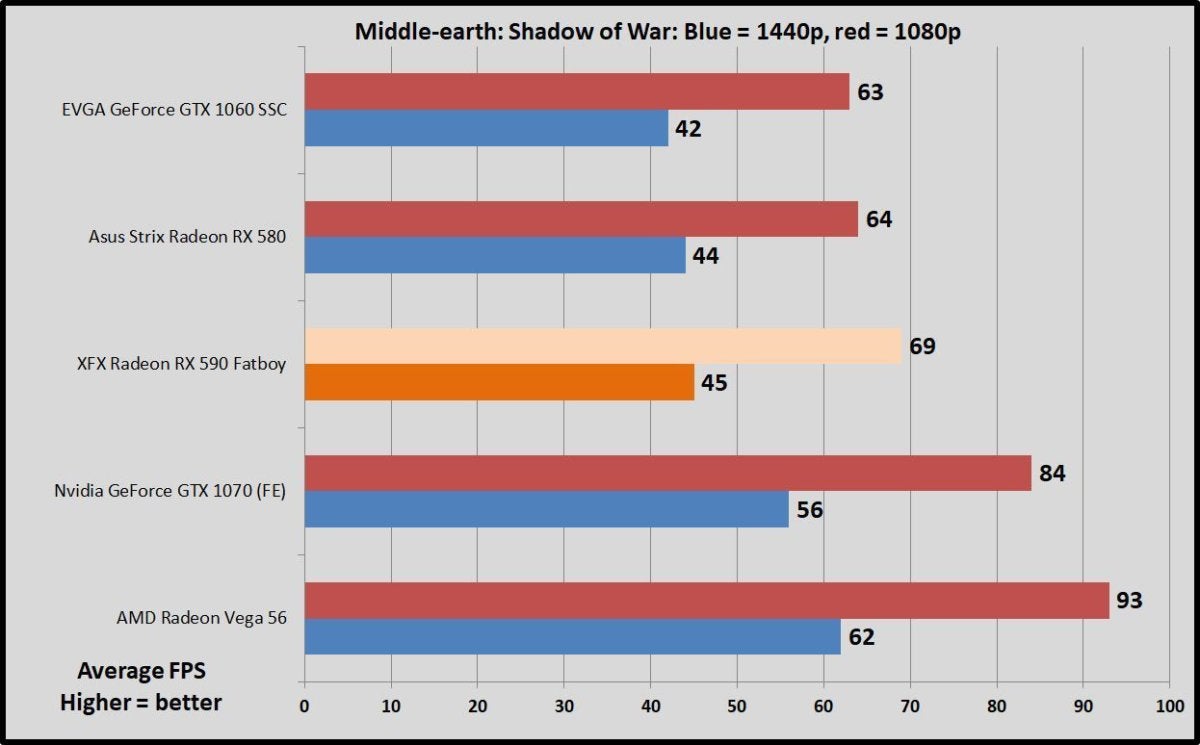
 The Fatboy keeps its lead, triumphing over the EVGA GTX 1060 SSC away 9.5 percent at 1080p resolving. It continues to outpace the RX 580 by about 8 percent at 1080p, though the performance gaps in effect come together at 1440p.
F1 2018
The latest in a lank stemma of successful games, F1 2018 ($60 on Humble) is a benchmarking gem, supplying a wide array of some in writing and benchmarking options—qualification it a much more reliable option that the Forza series. IT's stacked on the quaternary version of Codemasters' oily-smooth Egotism game engine. We test two laps on the Australia course, with clear skies.
 Brad Chacos/IDG
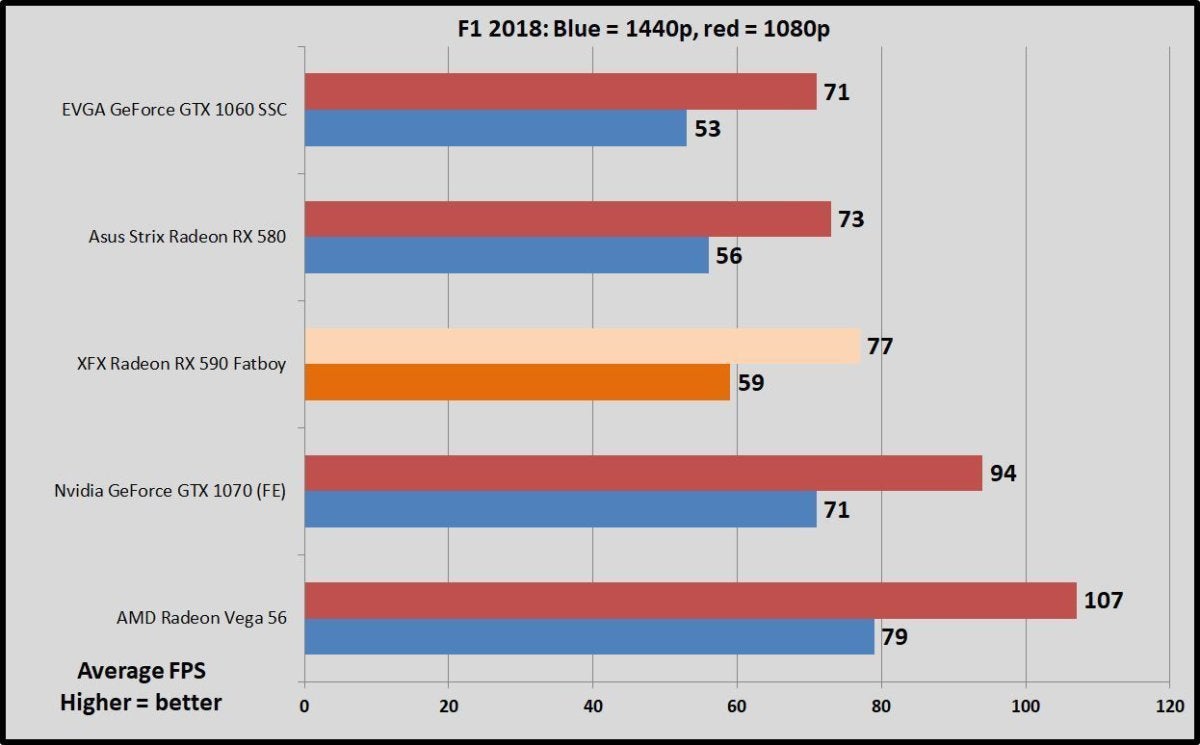
 The trends we've been seeing continue here. The XFX Fatboy is noticeably faster than the overclocked EVGA GTX 1060 SSC, slightly faster than the Asus Strix RX 580, and much slower than the much more expensive Vega 56 and GTX 1070.
Next page: Gaming benchmarks close
Ashes of the Singularity: Escalation
Ashes of the Uniqueness ($40 connected Humiliate) was combined of the very first DX12 games, and information technology remains a flagbearer for the technology to this day thanks to the extreme scalability of Oxide Games' next-gen Element engine. With hundreds of units onscreen simultaneously and any serious nontextual matter effects in play, the Crazy preset can wee graphics cards sweat. Ashes runs in both DX11 and DX12, but we only test in DX12, as it delivers the best results for both Nvidia and AMD GPUs.
 Brad Chacos/IDG
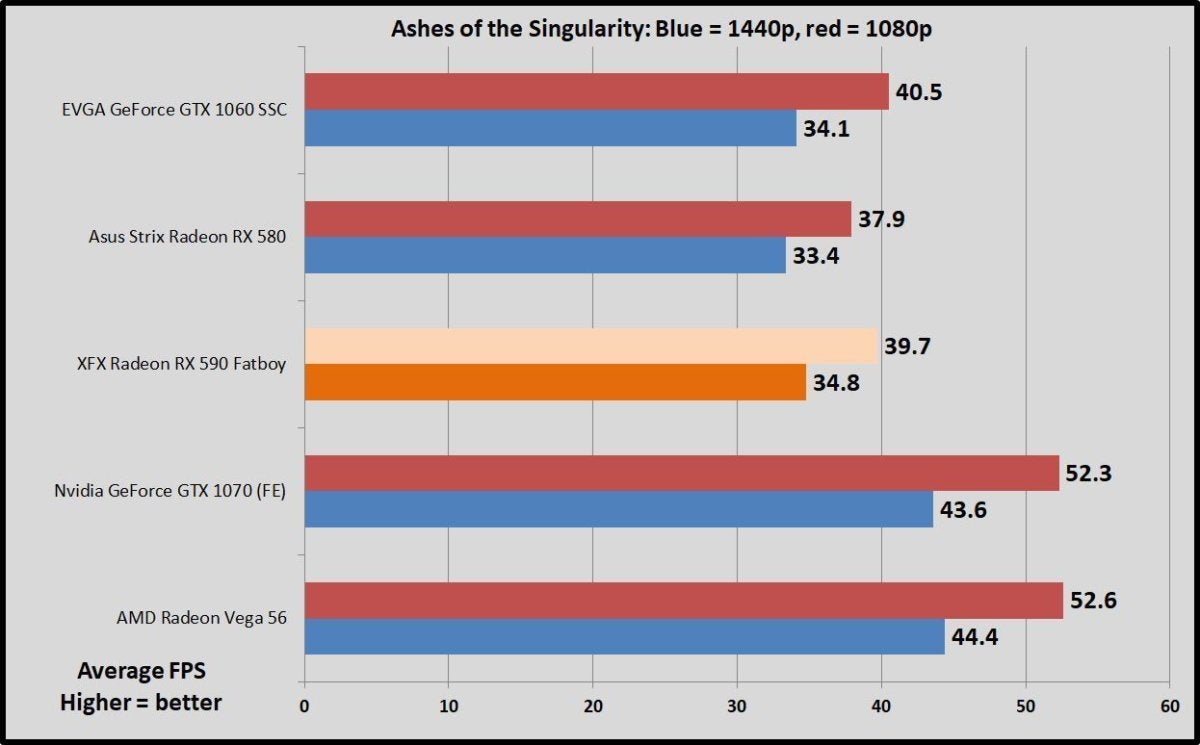
 Nvidia's set back a good deal of work into optimizing for Ashes, and IT shows.
GTA V
We'atomic number 75 sledding to wrap things leading with a couple of older games that aren't really visual barnburners, but still apical the Steam charts twenty-four hours-in and day-outgoing. These are games that a lot of masses play. First up: Marvelous Thievery Auto V ($30 happening Unskilled) with all options turned to Very High, all Advanced Graphics options except extended shadows enabled, and FXAA. GTA V runs on the Storm engine and has received substantial updates since its initial plunge.
 Brad Chacos/IDG
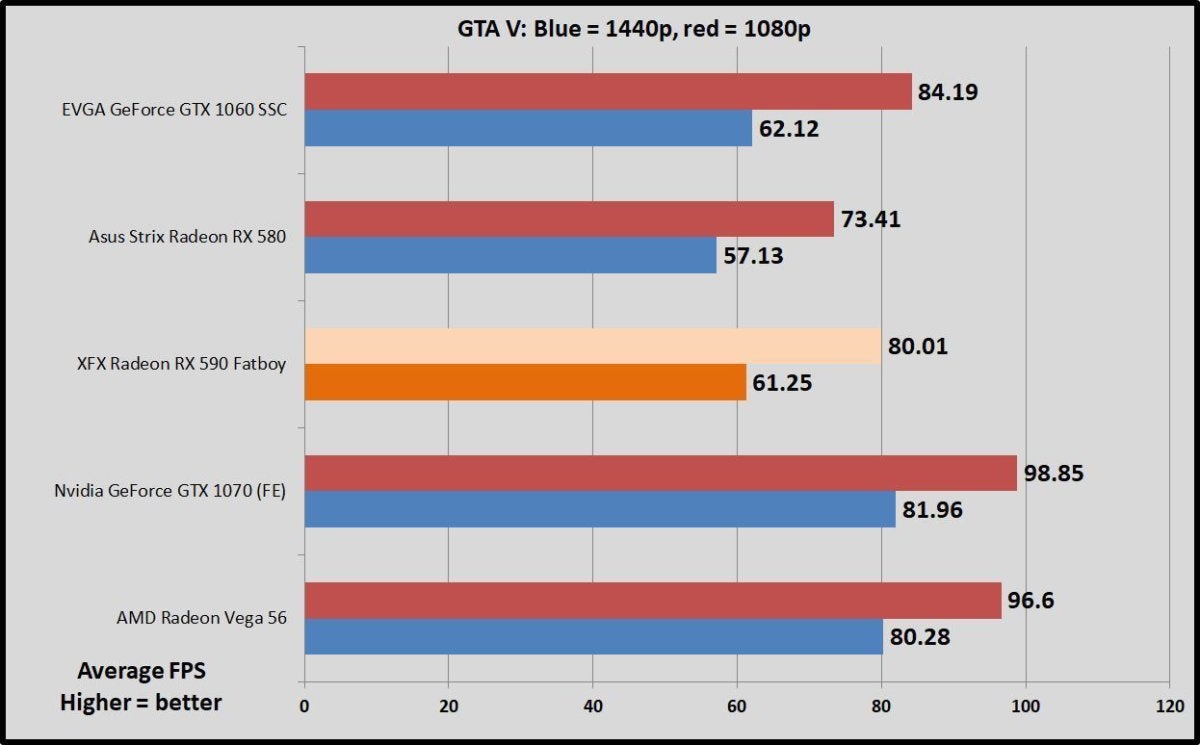
 GTA heavily favors Nvidia GPUs (and GTX more than RTX). This is the single definitive victory for the EVGA GTX 1060 SSC. The Radeon options notwithstandin deliver very playable frame rates at both resolutions.
Rainbow Six Siege
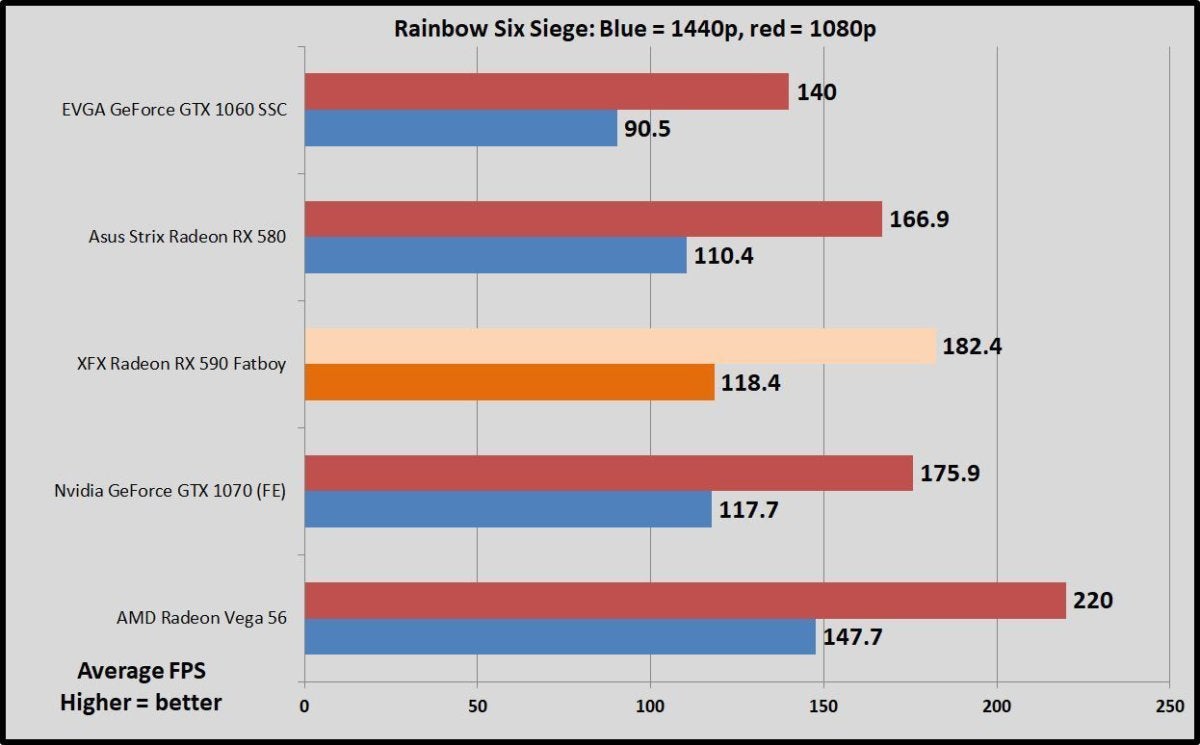
Finally, let's take a peek at Rainbow Six Siege ($40 along Inferior), a game whose audience just keeps on growing, and single that still feels like the simply unfeignedly next-gen shooter later on all these years. Like Ghost Recon Wildlands, this game runs on Ubisoft's AnvilNext 2.0 locomotive engine, but Rainbow Six Siege responds especially well to games that rest on async work out features.
 Brad Chacos/IDG
 As a counterpoint to GTA's Nvidia favoritism, Rainbow Six Siege adores the asynchronous compute capabilities found in Radeon graphics card game, and the AMD duo mops the floor with the GTX 1060. The XFX Radeon RX 590 is a stunning 30 percent quicker than the GTX 1060. Heck, it's even faster than the $380 GTX 1070 here. It's single near 10 percent faster than the Strix RX 580 at 1080p, though.
Adjacent page: Synthetics, power, thermals
Fire Strike, great power draw, thermals, and noise
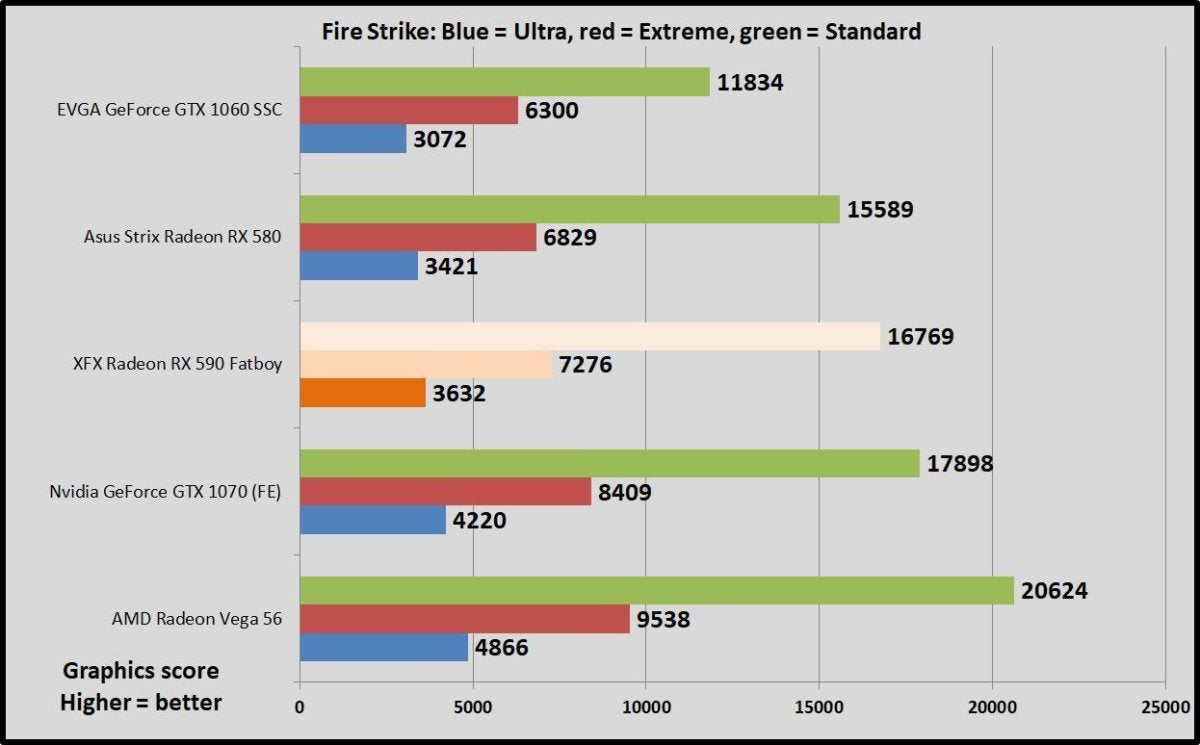
We too tested the GeForce RTX 2070 Founders Edition using 3DMark's highly respected Fire Work stoppage synthetic benchmark. Elicit Strike runs at 1080p (super acid bar), Discharge Strike Extreme runs at 1440p (red bar), and Blast Impinge on Ultra runs at 4K resolution (blue bar). All picture the same setting, but with more violent visual communication personal effects as you move up the scale, so that Extreme and Immoderate flavors stress GPUs even more. We record the graphics musical score to eliminate disagreement from the CPU.
 Brad Chacos/IDG
 Yep, everything falls about where you'd expect after observing the gaming benchmarks, which is always the case with Fire Strike.
 Brad Chacos/IDG
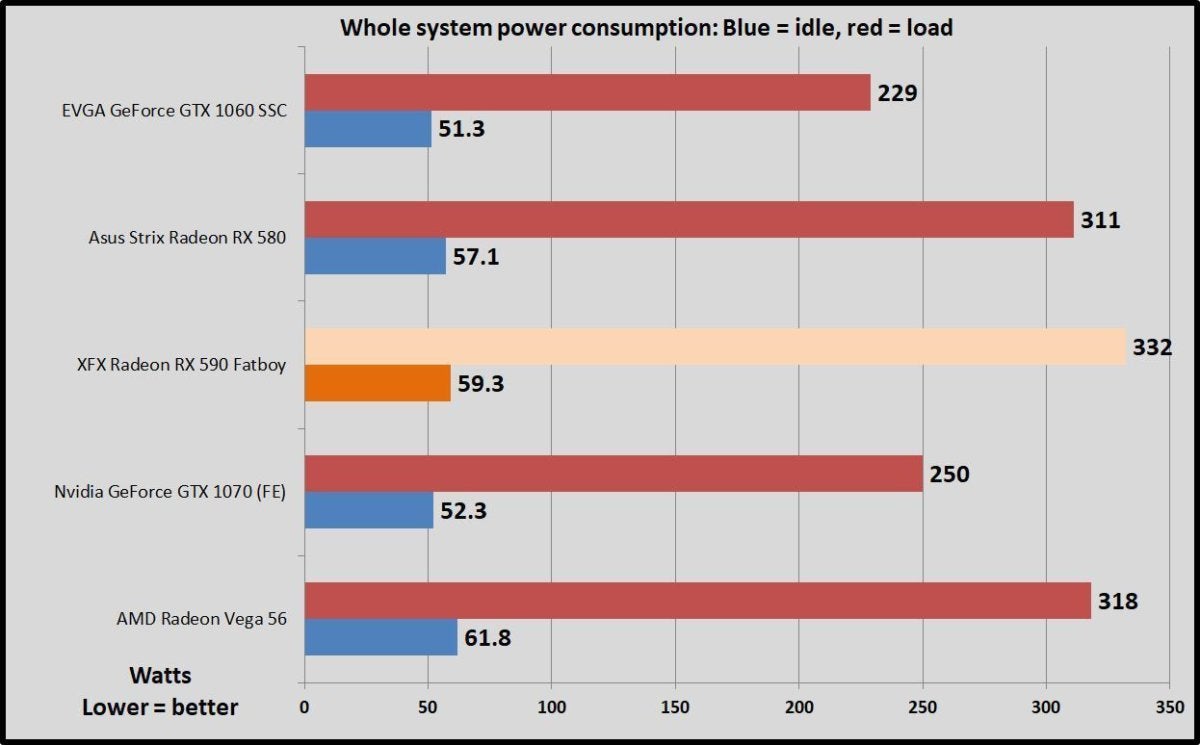
 We test mightiness pull up away looping the F1 2018 benchmark after we've benchmarked everything else with a card, and noting the highest reading on our Watts High Pro meter. The initial part of the race, where each competing cars are onscreen simultaneously, tends to embody the most demanding percentage.
Hither's where pushing AMD's Polaris GPU to its tired abut starts to testify more drawbacks. In ordain to crank the clock speeds so high and bunk the GTX 1060 so consistently, AMD cranked the Radeon RX 590's power consumption to 11, as well—move-to-12nm-architecture be blame. The XFX Fatboy draws over 100W more than the overclocked EVGA GTX 1060 SSC, and it requires even more vigor than the much more powerful Radeon RX Vega 56.
 Brad Chacos/IDG
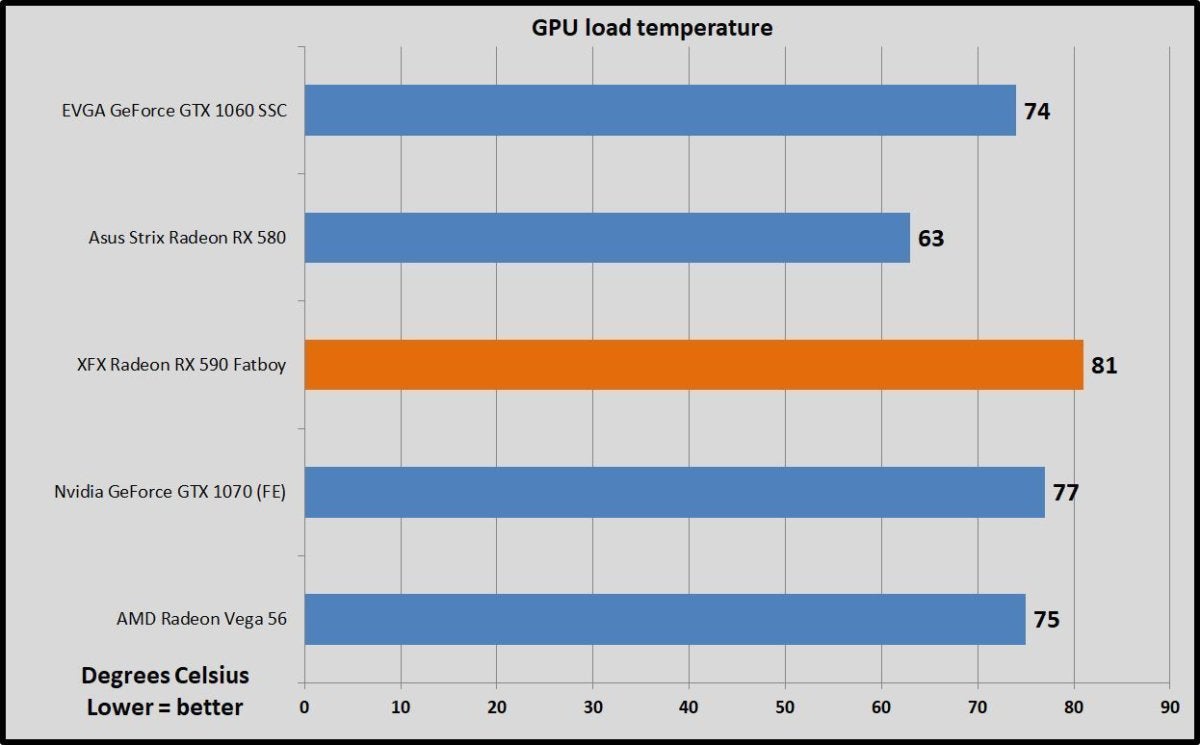
 We test thermals by leaving HWInfo's sensor monitoring tool open during the F1 2018 5-lap superpowe draw trial run, noting the highest upper limit temperature at the oddment.
This was the well-nig shocking find in this entire follow-up. I expected the Radeon RX 590 to constitute faster than the RX 580 and GTX 1060, and I potential it to draw more power to achieve those goals. But when I pulled the XFX Fatboy and its massive triple-one-armed bandit cooler out from its box, I did not bear this graphics card to come anywhere near 81 degrees Celsius under load. That's downright skilled compared to the other custom-cooled card game we've tested, yet much more powerful ones. The Fatboy's fans work gruelling to keep it even at this storey. This is one of the louder custom coolers we've tested in recent memory, though it's still far from loud. The Tranquillise BIOS brings the noise levels down by a fair amount. (We weren't able to test its performance impact, alas.)
AMD is clearly putting the pedal to the metal with the Radeon RX 590.
Next page: Should you buy the AMD Radeon RX 590?
Should you buy out the XFX Radeon RX 590 Fatboy?
Maybe, but it depends on a couple of factors.
The $280 Radeon RX 590 is a killer choice for no-compromises 1080p gaming, specially if you have a monitor faster than 60Hz. It's also a precise viable 1440p play option, especially if you don't mind dropping artwork settings down from Ultra to High, or have a FreeSync-compatible monitor to help smooth out your gameplay.
 AMD
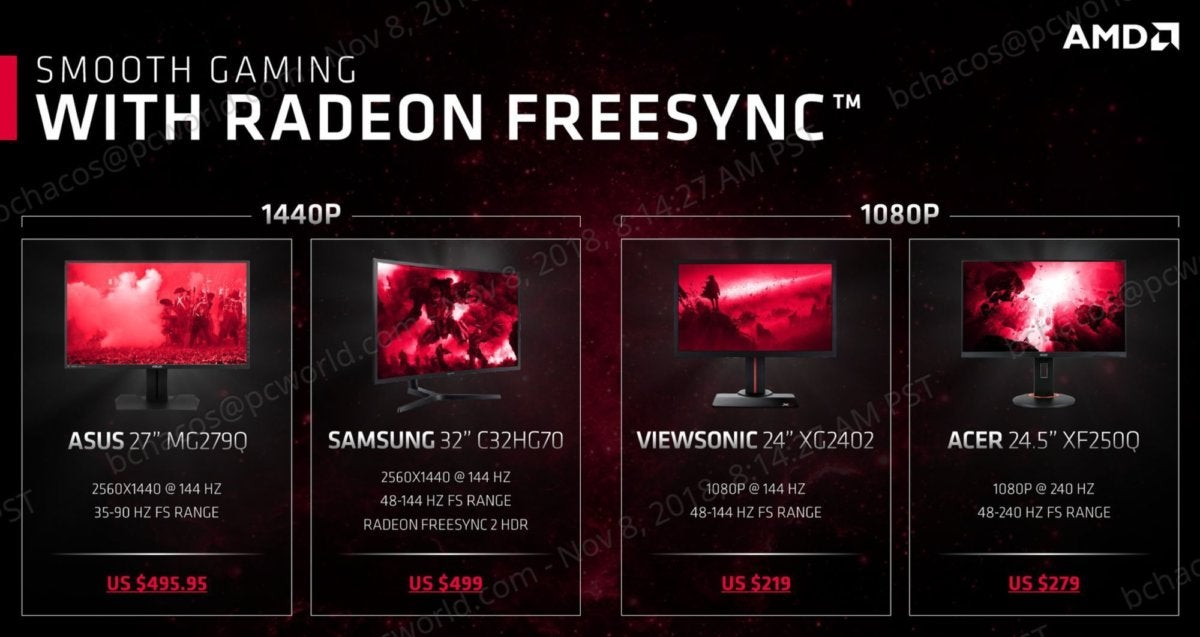
AMD Equal G-Synchronize monitors cost much to a higher degree this.
In fact, as part of the Radeon RX 590 press blitz, AMD horde home how a good deal Thomas More affordable the FreeSync ecosystem is compared to Nvidia's pricey G-Sync options—and it's right. The astray array of monitors you can buy without selling your firstborn is a feather in AMD's cap, and the Radeon RX 590 would glucinium a fine fit with a reasonably priced FreeSync panel.
When it comes to sheer performance, the XFX Radeon RX 590 beats the overclocked EVGA GTX 1060 SSC in bad much every game new than GTA V, and by a noticeable amount. In some games, like Phantasma of the Grave Looter and Rainbow 6 Siege, the Radeon RX 590 utterly womps the GTX 1060's frame rates—though Nvidia's GPU maintains a significant butt on in power consumption and heat levels. With comparable with dual-fan 6GB GTX 1060s still usually selling for $270 and supra, opting for the Radeon RX 590 feels like a zero-brainer, peculiarly with the three unimprisoned games AMD's throwing in.
The RX 590's big-boneless predecessor is the potential spoiler present, though. At 1,580MHz, the XFX Radeon RX 590 Fatboy's clock speeds measure in about 12 percent faster than the 1,411MHz we saw in custom options available at the RX 580's launch, like the Sapphire Radeon RX 580 Nitro+ and the Asus ROG Strix we retested today. Despite that, this custom Radeon RX 590 is only 7 or 8 percent faster than the custom RX 580 in most of the games we tested. In some scenarios it was even less.
 Brad Chacos/IDG
 That margin is notable, but IT's literally non game-changing. The Radeon RX 590 is a great 1080p and solid 1440p gaming card. So is the Radeon RX 580, albeit at somewhat less frames per second—and it's still being oversubscribed sledding cheeky, often at a sizeable discount. We've seen 8GB Radeon RX 580s on sale for around the $210 mark of late. At that Price, opt for the older card for 1080p play, unless all three costless games bundled with the RX 590 run into your fancy. (Though we didn't exam it hither, the $180-ish Radeon RX 570 is a great option for 1080p/60 gaming.)
Consider spending the supernumerary cash on the Radeon RX 590 if you're gaming at 1440p, though, as the encourage toilet facilitate it hit 60 fps in situations where the RX 580 falls just short. It's a great option if you deficiency to elevate to a more pixel-packed varan but shudder at the idea of spending $350 or more for a GTX 1070 or Vega 56.
At the end of the day, the Radeon RX 590 shows the limits of what a simple process quai can achieve with zero corresponding architectural changes. It's faster than the Radeon RX 580, but gently so. It also inevitably a lot more juice and throws off a lot more heat to achieve those gains, plane when paired with a thick, potent cooler like the XFX Fatboy's.
If you decide to accept an RX 590, we recommend projecting with a high-destruction usage variant like the Fatboy. Pushing Pole star this far clearly needs wholly the metal you can throw at IT. XFX also loaded this identity card up with ports abundant and a much-appreciated dual-BIOS. But make a point IT fits in your case before you buy!
No matter to whether you decide happening a Radeon RX 570, 580, or 590, one affair's certain—AMD has a chokehold on the best mainstream graphics cards around.
Eminence: When you purchase something after clicking links in our articles, we May earn a small committal. Study our associate link policy for more than details.

Source: https://www.pcworld.com/article/402905/xfx-radeon-rx-590-fatboy-review.html
Posted by: whittedsamer1990.blogspot.com
0 Response to "XFX Radeon RX 590 Fatboy review: Pedal to the heavy metal - whittedsamer1990"
Post a Comment